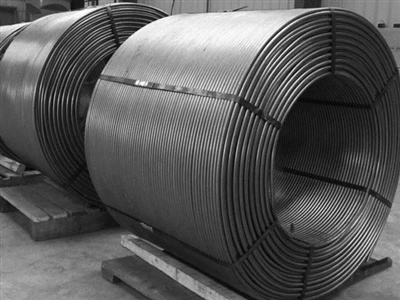
Key points of feeding line of silicon calcium cored wire
Many additives will be used in the process of steel smelting. If these additives are directly put into liquid steel, it is easy to reduce the temperature of liquid steel. Moreover, the particle size of the additives is not uniform, which will also affect the speed of smelting. The use of silicon and calcium wire for wire feeding operation can cut these additives into a uniform size, and also avoid the introduction of other impurities, more conducive to the steel smelting process. So what are the main points of feeding line operation?
The reaction between solid core pure calcium wire and molten steel is more intense than that of silicon calcium wire, so attention should be paid to calcium treatment operation, such as feeding depth and feeding line speed. In line feeding operation, due to the high pressure of calcium vapor on the solid core pure calcium wire, it is necessary to feed the solid core pure calcium wire deeply to prevent the natural evaporation of calcium. One way is to increase the iron sheet thickness to prevent the premature melting of the line from affecting the release depth of calcium. The other method is to increase the feeding velocity of ferroalloy to increase the release depth of calcium. The higher feeding velocity can make the solid core pure calcium line penetrate the slag layer and reach a certain depth, reduce the oxidation of calcium by slag, increase the absorption of calcium by molten steel, and improve the recovery of calcium.
The feeding line speed and the feeding line rhythm are the key parameters of the feeding line process. Too fast or too slow the feeding line speed and the feeding line will affect the melting time and oxidation degree of the silicon calcium line, which will affect the metallurgical effect. Therefore, it is necessary to always pay attention to the molten steel when using the silicon calcium line.