Anyang Fengfan Silicon Industry Co., Ltd., founded in 2010 on December 10, formerly anyang city yu macro metallurgy refractories co., LTD., founded in 1999 on June 12, has been more than 30 years of history.
-
![High Carbon Silicon]() High Carbon SiliconSilicon carbon alloy, also called High carbon silicon / HC silicon, it is a new and high efficient steelmaking alloy for converter, used in converter, smelting deoxidation alloying process. High...
High Carbon SiliconSilicon carbon alloy, also called High carbon silicon / HC silicon, it is a new and high efficient steelmaking alloy for converter, used in converter, smelting deoxidation alloying process. High... -
![Ferro Silicon]() Ferro SiliconFerrosilicon is a ferrosilicon alloy made of coke, steel chips, quartz (or silica) as raw materials, which is smelted in an electric furnace.
Ferro SiliconFerrosilicon is a ferrosilicon alloy made of coke, steel chips, quartz (or silica) as raw materials, which is smelted in an electric furnace. -
![Rare Earth Ferroalloys]() Rare Earth FerroalloysBrief introduction Rare earth ferroalloys are ferroalloys of rare earth elements and iron as the main components.Rare earth ferrosilicon is lumpy, metallic luster, hard and brittle, easy to crush....
Rare Earth FerroalloysBrief introduction Rare earth ferroalloys are ferroalloys of rare earth elements and iron as the main components.Rare earth ferrosilicon is lumpy, metallic luster, hard and brittle, easy to crush.... -
![Source Factory High Carbon Ferrochrome]() Source Factory High Carbon FerrochromeBrief introduction High Carbon Ferrochrome (HC FeCr) is a ferroalloy composed of chromium, iron, and carbon, and is a crucial member of the ferrochrome family. Despite its unfamiliar name, it is...
Source Factory High Carbon FerrochromeBrief introduction High Carbon Ferrochrome (HC FeCr) is a ferroalloy composed of chromium, iron, and carbon, and is a crucial member of the ferrochrome family. Despite its unfamiliar name, it is... -
![The Best Electrolytic Metal Manganese]() The Best Electrolytic Metal ManganeseBrief introduction Electrolytic manganese is widely utilized across multiple industries due to its unique properties. Its primary applications include: Use Electrolytic manganese is widely...
The Best Electrolytic Metal ManganeseBrief introduction Electrolytic manganese is widely utilized across multiple industries due to its unique properties. Its primary applications include: Use Electrolytic manganese is widely... -
![2025 Ferro Titanium]() 2025 Ferro TitaniumBrief introduction Ferro Titanium, an alloy composed of iron and titanium, is an important bridge connecting the steel industry and the titanium industry. It is not only an indispensable additive...
2025 Ferro TitaniumBrief introduction Ferro Titanium, an alloy composed of iron and titanium, is an important bridge connecting the steel industry and the titanium industry. It is not only an indispensable additive... -
![2024 Micro Carbon Ferro Manganese]() 2024 Micro Carbon Ferro ManganeseBrief introduction Micro Carbon Ferro Manganese is an iron alloy consisting of manganese and iron, with a carbon content typically ranging from 0.15% to 0.05%. The main feature of microcarb...
2024 Micro Carbon Ferro ManganeseBrief introduction Micro Carbon Ferro Manganese is an iron alloy consisting of manganese and iron, with a carbon content typically ranging from 0.15% to 0.05%. The main feature of microcarb... -
![Silicon Aluminum Calcium Composite Deoxidizer For Steelmaking]() Silicon Aluminum Calcium Composite Deoxidizer For Steelma...Silicon-aluminum-calcium is a new type of composite deoxidizer auxiliary material. It utilizes the active properties of silicon, aluminum and calcium. After being added to the ladle,...
Silicon Aluminum Calcium Composite Deoxidizer For Steelma...Silicon-aluminum-calcium is a new type of composite deoxidizer auxiliary material. It utilizes the active properties of silicon, aluminum and calcium. After being added to the ladle,... -
![Ferro Molybdenum]() Ferro MolybdenumFerroMolybdenum (FeMo60) is an alloy composed of iron and molybdenum. It typically contains around 60% molybdenum and 40% iron. This alloy has excellent mechanical properties, such as high...
Ferro MolybdenumFerroMolybdenum (FeMo60) is an alloy composed of iron and molybdenum. It typically contains around 60% molybdenum and 40% iron. This alloy has excellent mechanical properties, such as high... -
![Low Carbon Ferromanganese]() Low Carbon FerromanganeseBrief introduction Low carbon ferromanganese is an alloy product containing manganese and iron, with the main components being manganese, iron, and carbon. The main chemical components of...
Low Carbon FerromanganeseBrief introduction Low carbon ferromanganese is an alloy product containing manganese and iron, with the main components being manganese, iron, and carbon. The main chemical components of... -
![Microcarbon Ferromanganese #FeMn80C0.05]() Microcarbon Ferromanganese #FeMn80C0.05Brief introduction Silicon nitride is a metal alloy mainly composed of a mixture of Fe and Si3N4, which has superior properties such as high temperature resistance, oxidation resistance, and...
Microcarbon Ferromanganese #FeMn80C0.05Brief introduction Silicon nitride is a metal alloy mainly composed of a mixture of Fe and Si3N4, which has superior properties such as high temperature resistance, oxidation resistance, and... -
![2025 Factory Price Ferrosilicon Nitride]() 2025 Factory Price Ferrosilicon NitrideSilicon nitride is a metal alloy mainly composed of a mixture of Fe and Si3N4, which has superior properties such as high temperature resistance, oxidation resistance, and corrosion resistance. It...
2025 Factory Price Ferrosilicon NitrideSilicon nitride is a metal alloy mainly composed of a mixture of Fe and Si3N4, which has superior properties such as high temperature resistance, oxidation resistance, and corrosion resistance. It...


Why choose us?
Rich Experience
Providing technical support, troubleshooting, and maintenance services.
Production Market
The products are exported to domestic countries such as sichuan panzhihua iron and steel, shandong laigang yongfeng iron and steel, hebei jingye group, and foreign countries such as South Korea, Japan, Russia, Iran and so on.
Our Service
We will patiently introduce our company's products to customers, including product specifications, functions, performance, etc.
One-stop Solution
We will patiently answer all kinds of problems encountered by customers during the journey, as well as solve problems encountered by customers
in the later period of use .
Ferroalloy refers generally to ALLOYS of iron which contain a high proportion of one or more other elements than carbon. These include elements such as chromium, manganese or aluminum. The steel industry is the largest consumer of ferroalloys, as they impart various properties to steel alloys and stainless steel. In addition, ferroalloys play an important role in the production of the metal. For example, ferroalloys prevent the negative effects of sulfur in the production and improve the CORROSION RESISTANCE in steels.
In general, ferroalloys are produced in a blast furnace or an electric arc furnace, whereby the importance of the latter method declined steadily in the 20th century.
Other possibilities for the production of ferroalloys are by carbothermic reactions, the addition of elements into molten iron and by direct reduction.
Different types of ferroalloys
Since each ferroalloy serves a different purpose, many types exist. These are the most common.
Ferrochrome
Ferrochrome, also known as ferrochromium, typically consists of 50 to 70 % of chromium by weight. Basically, it is an alloy of chromium and iron. Ferrochrome is mainly used in the production of steel, which makes up for about 80 % of the world's consumption.
In general, ferrochrome is produced in an electric arc furnace. The production process is essentially a carbothermic reaction which is carried out at extreme temperatures near 2800 °C. A large amount of electricity is needed to reach these high temperatures. As a result, production in countries with high electricity costs is very expensive. The leading producer of ferrochrome is China, South Africa and Kazakhstan.
Ferromanganese
Ferromanganese is characterized by a very high content of the element manganese. It can be produced in a blast furnace. However, more common is the production in a submerged arc furnace, which is a type of electric arc furnace. This is achieved through carbothermic reduction. For this process, a mixture of manganese oxide, iron oxide and carbon is heated.
High-carbon ferromanganese is the most consumed ferroalloy worldwide in terms of quantity and is widely used in steelmaking. China is the main manufacturer of this ferroalloy.
Ferromolybdenum
Ferromolybdenum combines molybdenum and iron. This ferroalloy has a molybdenum content of 60 – 75 %. In the production process, molybdenum oxide is mixed with iron oxide and aluminium. An aluminothermy reaction follows. To purify the end product, an electro-beam melting is applied. The addition of ferromolybdenum leads to an improved corrosion and wear resistance and weldability.
Ferromolybdenum is mainly used in the production of ferrous alloys. Further applications are machine tools and equipment, military hardware, cars, trucks and ships. Moreover, it can also be applied in high speed tools steels and superalloy applications. The leading producers of ferromolybdenum are China, Chile and the US.
Ferronickel
Ferronickel is characterized by a nickel content of 35 %. The ferroalloy is obtained by a carbothermic reaction and is often applied in the production of austenitic stainless steels and nickel alloy steels. In 2008, the steel making industry made up to 98 % of the ferronickel consumption in the US. Further applications are electronics and the manufacture of batteries. The main ferronickel producers are Japan, New Caledonia and Colombia.
Ferrosilicon
Ferrosilicon is a ferroalloy which contains about 15 – 90 % of silicon by weight. Particularly high is the proportion of iron silicides. The manufacturing of the ferroalloy is carried out by reduction. In the process, silica, sand with coke or iron are used.
The main applications of ferrosilicon are in steel production. The ferroalloy helps to deoxidize steel and ferrous metals. Further, it improves hardness, strength and corrosion resistance. China is the main producer of ferrosilicon.
Ferrotitanium
Ferrotitanium is a ferroalloy which consists of 45 – 75 % of titanium. Further, iron and sometimes small amounts of carbon is added. For production, an induction furnace is used. In this, titanium, steel and iron are melted. Ferrotitanium is characterized by superior corrosion resistance, high strength and low density.
Mostly, ferrotitanium is applied in steel production. Further, the ferroalloy is used for deoxidizing and desulphurization. Main producers of ferrotitanium are Brazil, China and India.
Ferrotungsten
Ferrotungsten is a ferroalloy which is a combination of iron and tungsten. It is categorized into grade A (75 – 82 % W) and B (70 – 75 % W). In the production process, tungsten is converted into tungsten oxide. In the next step, it is heated with hydrogen or carbon. The resulting powder is mixed with iron. The raw material required is found in wolframite, scheelite and ferberite. The use of ferrotungsten increases the melting point of an alloy. As a result, the material is often used when the workpiece has to withstand high temperatures, for example in the aerospace industry.
Usages and Advantages of High Carbon Silicon
Silicon carbon alloy is a new type of alloy used in converter. It is commonly called silicon-carbon alloy, or high-carbon silicon. High-carbon silicon is a new type of high-efficiency silicon and carburizing alloy material made of high-purity carbon powder, metallic silicon powder and low sulfur and low nitrogen carbon materials by special processing technology.
The main usages
a) Used as a deoxidizer in the steelmaking industry. High-carbon silicon can replace ferrosilicon, silicon carbide and recarburizer, but also reduce the amount of deoxidizer. It is used in converter smelting deoxidation alloying process, and its effect is stable. The chemical composition of steel, mechanical properties and internal control quality are better than the traditional process;
Advantages of using high carbon silicon
a) Complete replacement of ferrosilicon and carburizer;
b) Increasing silicon and carbon efficiency and stability, and optimizing the steel material;
c) Reducing production costs and improving product competitiveness.
Silicon-carbon alloy is a new type of alloy which can replace most of ferrosilicon, silicon carbide and recarburizer,thereby reducing the use of deoxidizer.It is utilized for smelting deoxidation alloying process in converter and it has stable effect,with better steel chemical composition,mechanical properties and internal quality control than traditional process.
Performance and features:
1.Improve the quality of molten steel,steel quality and performance.
2.Reduce the use of alloy therefore to reduce the cost of steel-making,Increase economic benefits.
3.Save energy, reduce environmental pollution.
Ferro silicon is an alloy composed of iron (Fe) and silicon (Si), where silicon typically constitutes about 15% to 90% of the alloy's composition. The exact composition can vary based on the specific requirements of different applications. The alloy is produced by melting a mixture of iron and high-purity quartz (silicon dioxide) in an electric arc furnace.
Key characteristics and uses of ferro silicon include:
Deoxidizing Agent: Ferro silicon is commonly used as a deoxidizing agent in the production of steel. It helps remove oxygen from the molten metal, preventing the formation of oxides that could negatively impact the quality of the steel.
Inoculant in Cast Iron Production: It is used as an inoculant in the production of cast iron to promote the formation of graphite, improving the cast iron's mechanical properties.
Alloying Agent: Ferro silicon is an alloying agent used to introduce silicon into various metals and alloys. It is particularly useful in the production of stainless steel, where silicon enhances corrosion resistance and heat resistance.
Improves Electrical Properties: In some applications, ferro silicon is used to improve the electrical conductivity of certain materials, such as in the manufacturing of electrical transformers.
Foundry Industry: It is employed in the foundry industry for the production of iron and steel castings.
Magnesium Reduction: Ferro silicon can be used in the magnesium reduction process to produce magnesium from dolomite.
Specification:
FeSi 75
Si:75%min
Ferrosilicon: Particle Size & Shape Analysis
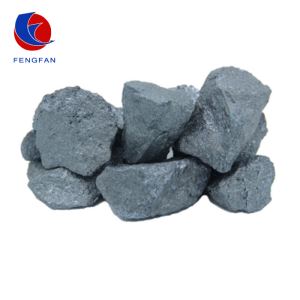
Ferrosilicon (FeSi) is an alloy of iron and silicon with a very variable silicon content between 10% and 90%. It is used as a so-called master alloy in steel production, which is added in small amounts in order to adjust the properties of the melt, the cooling process and the finished product.
The main advantage of FeSi is its deoxidizing effect (i. e. it reduces metals from their oxides), but it also helps to prevent the loss of carbon. Furthermore, ferrosilicon is used in electrode coatings and in the production of silicon, hydrogen and magnesium.
Ferrosilicon is produced either in a blast furnace or electric arc furnace by the reduction of quartz sand (SiO2) with coke in the presence of iron. The melt is poured out of the furnace and solidifies in the form of a flat sheet.
After cooling, this sheet is crushed by appropriate machinery and then further processed in a crusher. The resulting particle size distribution ranges from fine dust-like particles to cm-sized chunks. The FeSi is sifted into different size grades for further use.
Ferrosilicon is a ferroalloy - an alloy of iron and silicon. Its CAS number is 8049-17-0. The average silicon content varies between 15 and 90 wt%. It contains a high proportion of iron silicides. Ferrosilicon is produced by reduction of silica or sand with coke in presence of iron.
Ferrosilicon is known to possess good resistance to abrasion, good resistance to corrosion, high specific gravity, and high magnetism, which allows easy magnetic recovery. The melting point and density of ferrosilicon depends on its silicon content and it is available at a low cost.
The following sections will discuss the various properties of ferrosilicon in detail.

Chemical Composition
The following table shows the chemical composition of Elkem FeSi low Al ferrosilicon.
|
Element |
Content (%) |
|
Silicon, Si |
74 - 78 |
|
Iron, Fe |
≥ 21.32 |
|
Aluminum, Al |
≤ 0.50 |
|
Carbon, C |
≤ 0.050 |
|
Sulfur, S |
≤ 0.0030 |
|
Phosphorous, P |
≤ 0.020 |
Physical Properties
The following table discusses the physical properties of ferrosilicon.
|
Properties |
Metric |
Imperial |
|
Density |
3.20 g/cm3 |
0.116 lb/in3 |
|
Melting point |
1200-1250°C |
2192-2282°F |
|
Boiling point |
2355°C |
4271°F |
As a source of silicon to reduce metals from their oxides and to deoxidize steel and other ferrous alloys
Manufacture of other ferroalloys.
Manufacture of silicon, corrosion-resistant and high-temperature resistant ferrous silicon alloys, and silicon steel for electromotors and transformer cores.
Manufacture of cast iron, ferrosilicon is used for inoculation of the iron to accelerate graphitization.
Manufacture of prealloys like magnesium ferrosilicon, used for modification of melted malleable iron.
As an additive to cast irons for controlling the initial content of silicon.
In steel melting, casting, mineral processing and melting rod industry.
Used in the Pidgeon process to make magnesium from dolomite.
For heavy media separation and atomization.
Used in casting, melting and related metallurgy industry.
For production of semiconductor pure silicon in electric industry and silicon copper in chemistry industry.
What Is Ferrosilicon Made of?
Ferro silicon is a widely used alloy in various industrial applications. It is a ferroalloy composed of iron and silicon, with varying ratios of the two elements. Ferro silicon is commonly used in the steel and cast iron industries to improve the quality of the final product.
Composition of Ferro silicon
Ferro silicon is composed of iron and silicon with small amounts of other elements, such as aluminum and calcium. The silicon content in ferrosilicon can range from 15% to 90%, depending on the specific application. The higher the silicon content, the lower the melting point of the alloy. The iron content in ferrosilicon ranges from 25% to 75%.
The composition of ferro silicon affects its physical and chemical properties. The addition of ferro silicon to steel and cast iron alloys can improve their strength, hardness, and resistance to corrosion. Ferro silicon is also used in the production of silicon, which is used in the semiconductor industry.
Production Process of Ferro silicon
Ferro silicon is produced by smelting a mixture of iron and silicon in an electric arc furnace. The process involves the following steps:
Raw Materials: The primary raw materials for ferro silicon production are iron ore, coke, and quartz. Iron ore is used as a source of iron, coke is used as a reducing agent, and quartz is used as a source of silicon.
Mixing: The raw materials are mixed in a specific ratio and charged into an electric arc furnace. The furnace is lined with refractory material to withstand high temperatures.
Smelting: The mixture is heated to a temperature of around 2000°C using electric arc technology. The heat generated by the arc melts the raw materials, and the chemical reaction between iron and silicon produces ferro silicon.
Refining: The molten ferro silicon is then poured into a ladle and refined to remove impurities such as sulfur, phosphorus, and other non-metallic elements.
Cooling and Solidification: The refined ferro silicon is then poured into molds and allowed to cool and solidify. The resulting ingots can be further processed into smaller sizes, depending on the application.
Our Factory
Anyang Fengfan Silicon Industry Co., Ltd. is located in anyang, one of the seven ancient capitals of China, close to beijing-hongkong-macao expressway and nanlin expressway, with convenient traffic conditions, superior natural environment and abundant mineral resources, which provide advantaged conditions for the development of the enterprise. The company's leading products are: cored wire, silica-aluminum-barium calcium deoxidized alloy series,silicon metal, metal silicon powder, ferrosilicon ball, silicon carbon ball and other alloy pressure ball, silicon powder, rare earth ferrosilicon magnesium alloy, spheroidizing agent, etc. The products sell well in many large iron and steel enterprises and foundry enterprises at home and abroad. Anyang metallurgical material production base is one of the main manufacturers.

FAQ
We're well-known as one of the leading ferro alloy manufacturers and suppliers in China for 10 years. Our factory offers high quality ferro alloy made in China with competitive price. Welcome to place an order.
fesi ferrosilicon, ferro alloys raw materials, ferro alloy metal