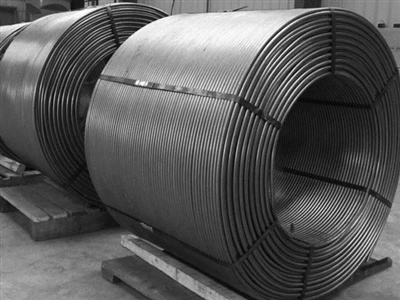
Seamless pure calcium cored wire calcium processing characteristics
Seamless pure calcium cored wire calcium processing characteristics are divided into four points, the next small series for you to explain what is specific. 1, calcium metallurgical characteristics: basic characteristics: melting point 850℃, boiling point 1480℃, density 1.55g/cm3, in the molten steel melting degree is close to zero, has a greater affinity for oxygen, liquid calcium can dissolve Al2O3 inclusion. Al2O3 in molten steel and calcium after treatment to form a large liquid inclusion, easy to float up. It reduces the nozzle blockage caused by excessive Al2O3 in molten steel and improves the pouring ability of molten steel. After calcium treatment, the Al2O3 inclusions remain spherical and improve the properties after rolling. 2. Treatment effect of calcium on molten steel: calcium is added into molten steel, and part of it dissolves into molten steel to become dissolved calcium in steel; Part of it evaporates in the form of steam; Some of them react with the Al2O3 inclusions or S in the steel to form impurities. In the process of refining and continuous casting after the treatment, such impurities float up into the slag, and the residual part remains in the steel as inclusions. Inclusion denaturation processing: Al2O3 into CaO-Al2O3 or CaO-Al2O3-CaS; CaS becomes CaOAl2O3-CaS. It can effectively change the fluidity of molten steel. Save the use of alloy and other deoxidized and desulfurized materials, save the cost of smelting. 3. The process principle and effect of seamless calcium line (high calcium line) : the condition of inclusion in molten steel is related to the amount, time and speed of adding calcium. Speed: Unsuitable feeding speed, low absorption rate of calcium, calcium evaporated; Suitable speed, calcium absorption rate is high, calcium evaporation is less. Time: After feeding the calcium line, the impurities in the steel were sampled immediately. The impurities in the steel changed obviously, and most of them were transformed into CaO-Al2O3-CaS inclusions, which were small in size and nearly spherical in shape, but not completely globalized. In the crystallizer sampling, most of the inclusions changed into CaO-Al2O3 inclusions and formed spherical, with low CaS content. CaO, Al2O3, CaS and Ca are all lower than those when the wire is just fed. When sampling in the billet, the inclusions change again and become CaO-Al2O3-CaS inclusions again. The shape is no longer spherical, but the size is slightly larger than that in the mould, because the segregation of S during steel solidification reacts with calcium to generate CaS, and then polymerize with the inclusions, and the size increases. The Al and O in the molten steel react and the inclusion expands again. Calcium feeding amount: the amount of feeding line (CASI line) should be enough to form 12CaO7 Al2O3 while considering the loss. It is generally believed that the residual calcium content in the steel after feeding line is 30-40ppm. The calcium denaturation treatment of silicon - calcium - cored wire, calcium - iron - cored wire, aluminum - calcium - cored wire and pure calcium - cored wire will also be very different. The residual calcium content in molten steel is also an important index of molten steel calcium treatment. When the mass fraction of acid-melted aluminum is 0.02-0.05%, the residual calcium content is 29ppm and Ca/Al is 0.058-0.145 in order to obtain liquid inclusions in the treatment. The test results show that W(Ca)/W(Al) : 0.13-0.20 is the best. 4. The composition of inclusion and the content of S and O in steel after feeding seamless pure calcium cored wire: S≤10* 10-4% in steel: CaO-Al2O3-CaS or CaO-Al2O3-Caas-MgO formed in steel. When S≥30* 10-4% in steel, the original O content in CaS steel formed in steel is high, then CaO formed by Ca and O should be fed at the end of O removal treatment.