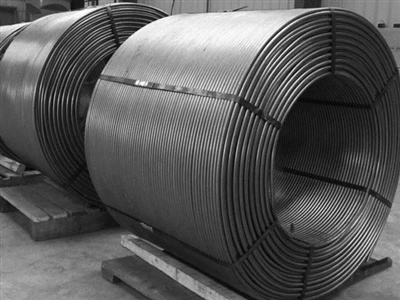
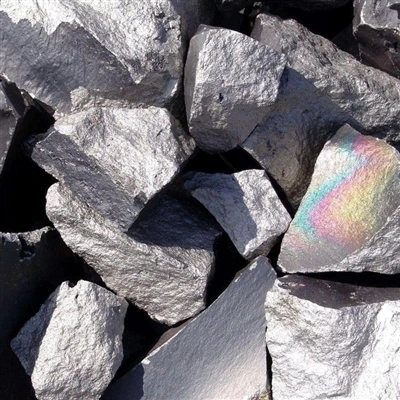
Ferrosilicon smelting operation
The silica, carbonaceous reducing agent and iron raw materials are weighed according to the number of ingredients, mixed and added into the furnace. Large-scale electric furnaces are mainly fed by feeding pipes and supplemented by furnace bed feeders. The operating procedure is: after the upper furnace alloy is discharged, the electrode is lowered, and the power is turned on; when the current reaches the specified value and is stable, the furnace is tamped with a stoker to destroy the remaining adhesive crust around the electrode of the upper furnace and push it to the center of the furnace, and then Cover new material. The normal sign of ferrosilicon smelting is that the electrode position is stable and deeply inserted into the charge; the electrode current is maintained at the specified value and the power supply load is stable; the material surface is evenly fired, there is no dead material area, and no "thorn fire" occurs; the material layer is soft, It sinks evenly around the electrode; the smelting crucible is large; the tap hole is easy to open; the iron flow is large, the iron output is stable and the slag can be discharged. As the smelting progresses, when a certain amount of ferrosilicon is stored at the bottom of the furnace, it will be released according to the specified smelting time. When smelting 75% Si ferrosilicon with an electric furnace above 10,000kVA, it is produced 4 to 5 times every 8 hours; when smelting 45% Si ferrosilicon, it is produced 5 to 6 times every 8 hours. The ferrosilicon liquid flows into the molten iron ladle. It is sent to the ingot casting room, after being calmed and removing the surface slag, it is poured into an ingot mold or casted with an ingot casting machine. In order to avoid the segregation of ferrosilicon, the thickness of FeSi75 ingot is less than 100mm, and the thickness of FeSi45 ingot is less than 150mm. To maintain normal furnace conditions and good technical and economic indicators, (1) the ratio of SiO2 and C must be accurately controlled. If the amount of carbon is insufficient, a large amount of SiO (gas) will be generated during the smelting process; part of the silica melts into slag, which makes the smelting crucible smaller and the smelting situation deteriorates; the electrode position is unstable, the material surface becomes dead, and the "stab fire" is serious; Recycling rate drops; power consumption increases. Conversely, if the amount of carbon is excessive, the charge resistance becomes smaller; more SiC is generated and suspended in the liquid alloy and slag phase, which increases the melt viscosity; the smelting crucible becomes smaller; the alloy discharge is difficult; at the same time, the electrode is inserted into the charge. Shallow, serious "stabbing fire" on the material surface. The relationship between the amount of carbon in smelting FeSi75 and the silicon recovery is shown in Figure 5. (2) Use a reducing agent with high specific resistance and good reactivity. The relationship between the reactivity of carbonaceous reducing agent and the power consumption of FeSi75 smelting is shown in Figure 6. (3) Appropriate electric furnace geometry and smelting power supply parameters, and reasonable charge particle size are also important for smelting.