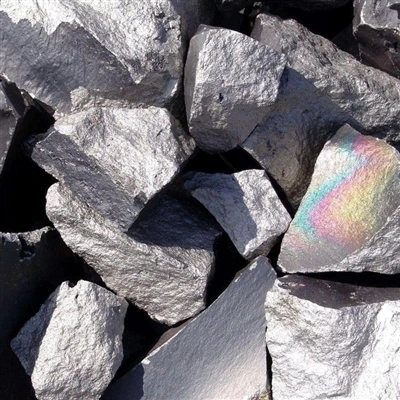
The classification of silicon metal is usually based on the content of the three main impurities, iron, aluminum and calcium, contained in the silicon metal composition. According to the content of iron, aluminum and calcium in silicon metal, silicon metal can be divided into 553, 441, 411, 421, 3303, 3305, 2202, 2502, 1501, 1101 and other different brands.
Industrially, silicon metal is usually produced by reducing silicon dioxide from carbon in an electric furnace. Chemical reaction equation: SiO2 + 2C → Si + 2CO The purity of silicon produced in this way is 97~98%, called metallic silicon. Then it is melted and recrystallized, with acid to remove impurities, purity of 99.7~99.8% silicon metal.
Silicon metal is mainly composed of silicon, and therefore has similar properties to silicon. There are two allotropes of amorphous silicon and crystalline silicon. Amorphous silicon is a gray-black powder that is actually a microcrystal. Crystalline silicon has diamond crystal structure and semiconductor properties, melting point 1410℃, boiling point 2355℃, Mohs hardness 7, brittle. Amorphous silicification has active chemical properties and can burn violently in oxygen. It reacts with halogens, nitrogen, carbon and other non-metals at high temperature, and can also interact with magnesium, calcium, iron and other metals to generate silicates. Amorphous silicon is almost insoluble in all inorganic and organic acids, including hydrofluoric acid, but soluble in acid mixtures of nitric and hydrofluoric acid. Concentrated sodium hydroxide solution can dissolve amorphous silicon and release hydrogen gas. Crystalline silicon is relatively inactive and does not combine with oxygen even at high temperatures. It is insoluble in either inorganic or organic acids, but soluble in mixed acids of nitric and hydrofluoric acid and in concentrated sodium hydroxide solutions.