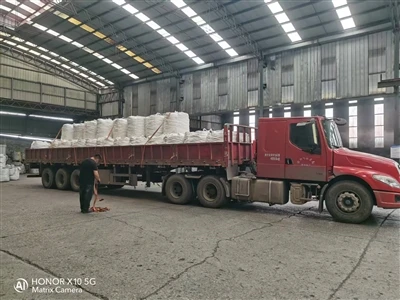
The process of smelting silicon metal
Metal silicon smelting requirements: furnace silica requirements have a certain granularity. The particle size of silica is an important technological factor in smelting. The suitable particle size of silica is affected by many factors such as the type of silica, electric furnace, capacity, operation condition and the type and particle size of reducing agent, and it should be decided according to the specific smelting conditions. Under normal circumstances, 6300KVA three-phase electric furnace (Dawu Silicon Factory was built in 1983) requires silica particle size of 8-100mm, and 3200KVA three-phase electric furnace requires silica particle size of 8-80mm, and the proportion of intermediate particle size composition is larger. When the particle size is too large, because it can not adapt to the paste and reaction speed of the ramming furnace, it is easy to make the unreacted silica enter the liquid silicon, resulting in the increase of the slag amount, the difficulty of discharge, the reduction of silicon recovery, the increase of energy consumption, and even cause the rise of the bottom of the furnace, affecting the normal production. Although the particle size is too small, it can increase the contact surface of the reducing agent, which is conducive to the reduction reaction, but the gas produced in the reaction process can not be discharged smoothly, and it will slow down the reaction speed. The granularity is too small. The impurity brought in will increase, affecting the quality of products. In the production of silica generally less than 5mm is not suitable for use.