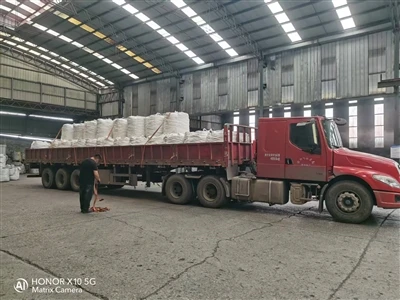
The main uses of petroleum coke
The main applications of petroleum coke are pre-baked anode and anode paste used in electrolytic aluminum, carbon industry, graphite electrode, industrial silicon smelting and fuel.
According to the structure and appearance of petroleum coke, petroleum coke products can be divided into four types: (1) Needle coke, with obvious needle structure and fiber texture, is mainly used as high power and ultra-high power graphite electrode in steel making. The production process and raw materials of needle coke have special requirements due to the strict quality index requirements in sulfur content, ash, volatile matter and true density. (2) Sponge coke, with high chemical reactivity and low impurity content, is mainly used in aluminum industry and carbon industry. (3) Projectile coke or spherical coke: round spherical in shape, 0.6-30mm in diameter, generally produced from high sulfur, high asphaltene residue, and can only be used as industrial fuel for power generation, cement, etc. (4) Powdered coke:Produced by fluidized coking process, it has fine particles (0.1-0.4mm in diameter), high volatile content and high thermal expansion coefficient, and cannot be used directly in electrode preparation and carbon industry.
According to the difference of sulfur content, it can be divided into high sulfur coke (sulfur content above 3%) and low sulfur coke (sulfur content below 3%). Low sulfur coke can be used as anode paste and pre-baked anodes for aluminum plants and graphite electrodes for steel plants. Among them, high quality low sulfur coke (less than 0.5% sulfur) can be used to produce graphite electrodes and carbon enhancers. Low sulfur coke (sulfur content less than 1.5%) is commonly used in the production of prebaked anodes. Low-quality petroleum coke is mainly used for smelting industrial silicon, silicon carbide and producing anode paste. High sulfur coke is generally used as fuel for cement plants and power plants.
Calcined petroleum coke: In the graphite electrode for steel making or anode paste (fused electrode) for aluminum and magnesium making, in order to adapt the petroleum coke (raw coke) to the requirements, the raw coke must be calcined. Calcination temperature is generally around 1300 ℃, the purpose is to get rid of the petroleum coke volatile points as much as possible. This reduces the hydrogen content of petroleum coke reproducts and makes the petroleum coke more graphitized, thus improving the high temperature strength and heat resistance of graphite electrodes and improving the electrical conductivity of graphite electrodes. Calcined coke is mainly used in the production of graphite electrode, carbon paste products, diamond, food grade phosphorus industry, metallurgical industry and calcium carbide, etc. The most widely used one is graphite electrode. Raw coke can be used directly for calcium carbide as the main material of calcium carbide, silicon carbide and boron carbide as abrasive material without forging. It can also be used directly as coke for blast furnace or blast furnace wall lining carbon bricks in metallurgical industry, and as dense coke for casting process, etc.
![VL$YF(RW05_T2]L5LO[VQ7L](/Content/uploads/2022653999/2022061509170186bc9d860cc040f5bf9842339d9945c0.png "VL$YF(RW05_T2]L5LO[VQ7L")